
The Lime Swallowtail
- Tejaswini J
- Sep 28, 2020
- 6 min read
Updated: Sep 29, 2020
The butterfly is a flying flower, The flower a tethered butterfly. -Ponce Denis Ecouchard Lebrun
I have had my own version of ‘Into the wild’ experiences for birds, butterflies and any wildlife form. Every time I returned with an awestruck brain freeze, always surprised with the wonders of nature and its mysteries. Outside of these planned expeditions though, I haven’t much-noticed anything apart from birds.
Given our current situations, I could only do limited birding during the lockdown, the setbacks of living in an urban setting. I had had enough of Instagram and Netflix I was so ready for life to restart.
One day when I was sitting at home contemplating life (If it should be amazon or Hotstar next), it dawned upon me that I could observe butterflies since they are found aplenty in urban settings. I had basic knowledge about butterflies but I wasn’t interested in them like I was towards birds.
The first few times I tried fostering caterpillars, it was a big disappointment since the eggs never hatched. Almost a year later during the lockdown here I was with my renewed resolve to further my knowledge about butterflies. I had an eye for butterflies of the swallowtail family because of their small tail-like projection at the end of their hind wings making a distinct fashion statement.
One morning, I walked out of my room to the balcony expecting another day filled with boredom. I made my first independent observation of a Lime Swallowtail laying eggs on my mother’s tiny lemon plant. Butterflies identify the host plant by tasting the leaves of the plant with their feet. They reject plants based on its vitality, presence of other similar life forms in terms of competition for food and exposure to predation.

My mom's small balcony garden
It nostalgically reminded me of my first experience of missing a butterfly laying eggs. I was on one of my first nature walks on my college campus with a senior. When all I could see was a green butterfly (I later learnt, that butterfly was called Tailed Jay) fluttering around, he alerted that it was pregnant and was about to lay eggs. Before I could finish asking him how he knew about it, the butterfly had finished laying eggs on a nearby plant and had flown away. He showed me the leaf with the eggs. I was speechless, to be honest. I still have not found words to describe what I felt then. I was awed by the beauty of it, mesmerised and dumbstruck. Ok, I am digressing. Back to the Lime swallowtail.
Fortunately, this time I caught up with what was happening quick enough and witnessed the Lime Swallowtail still laying eggs. I called my mom to share this experience! Enviously she was quick enough to grasp what was going on the first time itself. That’s the plus side of doing a lot of reading so when something happens you know what to look for. After mama butterfly left, we checked the plant and found three eggs on the underside of the tender lemon leaves.


Freshly laid eggs about 1.2mm in diameter Mature eggs with a dark purple colouration
The Life Cycle:
I had to wait two and a half days before they hatched! (Yes, this time all three of them hatched. Yay!!!). This was probably the most anxious wait of my life (Not really, there is still the pupal stage but I didn’t know that then). The caterpillars had come out and were done with their first meal (the eggshell) too. My mom had wanted to bring that lemon plant with the eggs inside to keep them safe from parasitic wasps but I stopped her from doing so lest the sudden change in the environment yet again resulted in the eggs not hatching. Now that the eggs had hatched, I happily brought the plant in along with the caterpillars.
They were so tiny just 2.7mm. They looked like they had goosebumps all over because of their spiky appearance and were crawling around like headless chickens. Whoever told you that caterpillars are disgusting and dull were either ignorant or ignorant and oblivious.


During the first instar, the caterpillars reached a length of 4mm
The caterpillars grew quite quickly from one instar to another. With every stage, the caterpillars become less and less spiky. The small lemon plant which had taken 6 months to grow from seed to the current stage was at the verge of going completely leafless, thanks to the caterpillars.
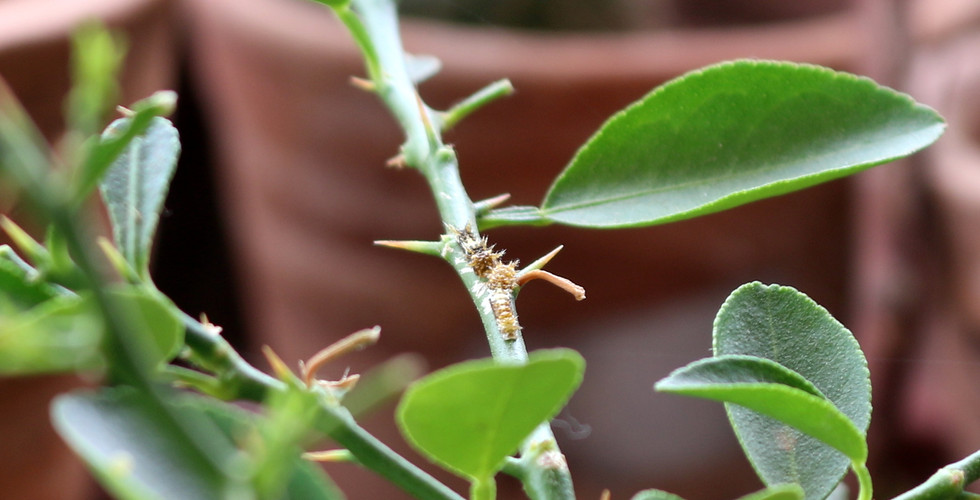
By the end of the second instar, they reached around 10mm in length
As I observed their feeding habits through these larval instars, I realised that they can almost triple and quadruple their food intake. What was once, a fresh tender leaf eaten a little bit when they hatched becomes one big twig of leaves devoured in hours. How amazing. This is the reason they are considered invasive pests in citrus plants.
During the third instar, the white band in the middle of their body becomes more prominent. Yet another instance of camouflage that we can so easily miss, these caterpillars literally resembled bird poop. This tactic could save the caterpillar from their predators. Isn’t that just brilliant?


The caterpillars had grown to a size of around 14mm during the third instar.
Until the fourth instar, the caterpillars continue to look like bird poop. (Caterpillar 1: You can’t see me; I am bird poop!). The caterpillars resemble the previous instar but are slimier and darker in colour.


Fourth instar caterpillars in the initial stage Fourth and fifth instar caterpillars
The fifth and last instar gets quite interesting in certain butterfly species of swallowtail family. The caterpillars moult into a beautiful green colour leaving the bird poop camouflage behind. They have a bullet train like appearance. This instar sees a drastic increase in their appetite. I have read that a caterpillar’s food consumption has a direct bearing on the completion of its metamorphosis and reproductivity. Anyways it is fun to watch them munch away on the leaves.


At the end of the fifth instar, the caterpillars reached the size of around 41mm!
At the end of the fifth instar when they near the pupal stage (This stage is called the prepupal stage), they remain motionless for a while before the urge to explore the immediate surroundings around them takes over. It is probably the most active they are during their life cycle. They wander restlessly in search of a place to pupate. When they finally chose “the spot”, they stay dormant for some time. They spin the silk pad and silk girdle and attach themselves to the spot. They form a C-shape with their body and at this stage, the caterpillars moult for the last time. After the final moult, the skin falls off and the chrysalis is formed.


Pre pupatory larvae gearing up for forming a chrysalis
Lime swallowtails have two colour formations of chrysalis; the brown and the green form. The former is seen when the caterpillars attach themselves to dark surfaces and the latter when they get attached to lighter surfaces. This is to avoid attracting predatory attention.
Now comes the most anxious wait! I missed the caterpillars in action, duh. My mom and I checked on them regularly to make sure they were okay. The chrysalis takes about 7 to 8 days on an average to change colour and turn dark. The pupal encasing starts to turn transparent and the spots and colouration on the forewing of the butterfly can be seen through. From this stage, it takes anywhere from a few hours to a day for the butterfly to emerge. In our case the following day the butterfly emerged.


The green form of chrysalis against a light The brown form of chrysalis against a dark background background


Side and bottom views of the final stages of the chrysalis.
Once the butterfly is ready to emerge it only takes a few seconds for it to break its pupal case and crawl out. The next few minutes the butterfly concentrates on expanding its wings to its fullest. If not done within this time, and blood circulation to the wings do not start the butterfly may end up crippled. It then proceeds to hang itself upside down and dry its wings for the next few hours. Only by then, it is ready to fly away.


A freshly emerged lime swallowtail drying its wings before flying away.
After I set my three butterflies free, (2 males and one female) I began looking for more butterfly eggs in my neighbourhood and observed the life cycle of many more species. Absolutely mindblown by butterflies and their biology. I guess I have the mama Lime Swallowtail to thank for! And my mom too for sharing my madness for all things wild.


Female Lime swallowtail Male Lime Swallowtail
Comments