
Wild Goa - The unsung view
- Tejaswini J
- Nov 15, 2020
- 7 min read

Chorao, here I come!
My one-month semester break was nearing and I was itching to make use of this break doing something I loved the most, of course being in the wild. Perfect time to intern, I applied to a few places and landed myself an internship with ‘Wild Otters’. It was a three-week program researching on Otter Ecology’ based out of Chorao Island. Perfect!!!
The day I boarded the bus to take me to my destination, I was anxious, excited and totally ready for what those internship days held. Or so I thought. During the cab ride from Panjim bus stop, I had to ask the cab driver to stop multiple times being a typical tourist taking pictures of everything possible. I was floored by the beauty surrounding me, the deep blue waters and the serene green background. He must have been used to lunatics like me, because he did everything I asked, without batting an eyelid.
And then came one of the most unforgettable memories of Goa, the Chorao Ribandar ferry across Mandovi river. I was like a kid tasting candy for the first time. I failed miserably at my attempt to act cool in front of all those people around me. No surprises there! The scenic beauty had me in her trance so much that I was on a mission to empty my memory card by clicking everything in sight. I think at the end of the ferry ride the camera felt slightly hot in my hands. 😊
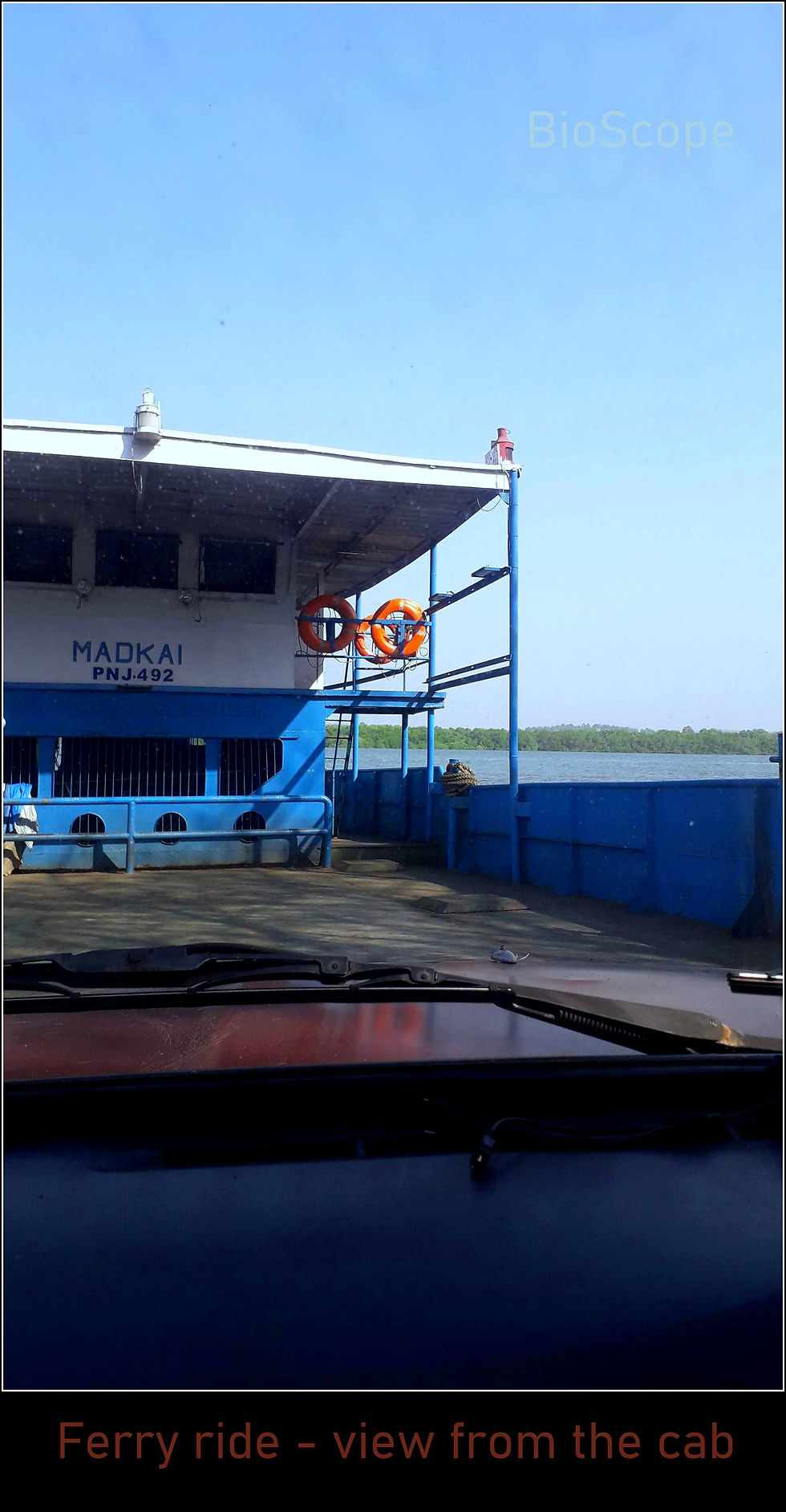


My travel seems to be picking up a cosmic pattern. It was yet again dramatic since neither I nor the cab driver knew how to get to the Wild Otters base camp. After being lost for a while, (not that I minded a bit) we finally made it to the base camp.
An ancient Portuguese house, surrounded by wild vegetation, chirping birds, garden lizards basking, colourful butterflies and moths, lurking civets and apparently even snakes, was what I called home for the next three weeks. The small porch in the front turned out to be a resting spot for bats and butterflies in the evening. What a welcome company. This was my picture-perfect location to tame my craving for nature.

Found a friend
I met another intern Ekadh there, who I found to be the perfect calm to my incessant wild. We were friends at first sight. He had many stories to tell me about all the activity that goes on in the night, weird calls he had heard, palm civets running up the roof, owls hooting in the distance and sometimes even nightjar calls. He also mentioned spotting a banded krait when he was hanging out near the porch. Ekadh and I took turns in making Maggi and it was my turn this time. The stainless-steel utensil had a glossy covering on the outside which both of us dint know could be plastic. A quick deliberation and we decided to experiment. Bad move! Before I could open the Maggi packet, the vessel was on fire! RIP vessel. After somehow putting out the fire between episodes of panicking and googling, I took another steel vessel to microwave my noodles. This time though Ekadh saved us from one more incident. Thinking back, I realise it was one of the first hilarious exposure of our inexperience. To this day we recount these incidents and have a hearty laugh.


Mangrove ecosystem
Curious about the mangroves in the island, I did some reading about them, and came across some interesting facts. They are one of the most significant and productive ecosystems protecting the coastline from erosion, storms and hurricanes, thwarting damage to coral reefs and other marine lives. They sustain so many life forms, from crabs, fishes, coral reefs to lobsters and in instances like Chorao, even otters!


The mangroves have roots that come out of the soil for air. The long stick like structures are the roots called pneumatophores.


The mud lobster builds mounds with wet mud and is almost never seen outside its mound!
One of the Research Assistants who I was assisting, suggested that Ekadh and I take a break and visit the famous Salim Ali Bird Sanctuary during the weekend. The boat ride inside the sanctuary is etched in my memory forever. Apart from spotting numerous birds including the Osprey, Black capped kingfisher and the White collared kingfisher, I also got to meet Mr. Uday Mandrekar. I had watched a video on how he came to be called as the “bird man of Chorao”. A boatman who is well versed with the avian diversity of the place is not quite common. Throughout the boat ride he named all the bird species we saw and spoke in detail about the wader birds. He also stopped a couple of times near the mangrove swamp to show us mudskippers jumping around in the mud. His incredible work on educating the tourists about the importance of mangroves and clearing all the litter along the mangrove swamps to help improve the quality of water for the aquatic organisms is inspiring!

The boat ride into the Salim Ali bird Sanctuary!

Our personal time with nature
Ekadh an avid birder like me, needed no convincing to get up early, or go out in the evening even after a long day for birding, and whenever else we could squeeze in a casual walk during our busy routine. Every other night we tried our hand at herping too, keeping an eye out for nocturnal animals. Some nights were more interesting than others. Imagine flashing a torch and seeing numerous eyes watching you, from the tree top branches to bushes on the side and hearing eerie sounds. After that experience we had Chuku, the pet dog from the base camp, accompany us on our night tours. Though we couldn’t spot any snakes in the night, we did see a Bronzeback right from the window of our dorm room. That is herping enough for me. Of all my sightings in and around the base camp, the most special one is that of a bicoloured frog. Of all the places it was in the basecamp washroom and wouldn’t move. Hah!


One of the days of our field visits while waiting for the ferry, Ekadh in an attempt to get some close-up shots, walked down the slanting ramp that was meant to help vehicles get into the ferry. Wet and slippery due to mud, Ekadh’s attempts to climb back up or call us for help, both turned out to be futile. After being saved by fellow travellers, Ekadh returned to our group with muddy hands and legs, grumbling the entire trip how he had to wash his jeans.
Although I had wanted to see civets since the beginning of my internship, I had hardly sighted any until the last few days of my stay there. I was on a night walk per usual and was focussed on a spotted sailor butterfly resting under the leaves, when I heard the sudden rustling of leaves above me. We could see a cat like creature jumping from branch to branch! It was a palm civet trying its best to not be spotted. We watched it until it disappeared amidst the dense foliage. With its elusive nature I was satisfied with the brief glimpse I had had. Though there was not much activity during our night safaris, it still was a goosebumps worthy experience for me.
Bat Calls (not cat calls)
I experienced so many of my firsts in Goa, but observing bats and recording their calls was an unexpected one. Bats are equally fascinating and interesting to study about, but I had no idea how to record them. They have frequencies above the normal hearing range of humans, which means we cannot hear most of their calls without a bat detector. Once set in the right frequency, they convert the frequencies of the bat calls to frequencies that is audible to humans. We had a couple bat detectors with us that night we went on our night safari. We heard numerous calls in different patterns throughout the night. There are around 1400 species of bats, and they make up one-fourth of the mammal population of the world. Fascinating!

During one of the night walks
A couple of old cycles in the property had been tempting Ekadh and he had been wanting to ride it. I hadn’t taken to the idea of taking it for a ride though, owing to its condition. He took the cycle out. It was a sight to see him all sweaty and red, huffing and puffing, returning to the base camp much later. I was hysterical seeing him pushing his cycle, rather than riding it. I think this has been the funniest trip by far, where Ekadh and I tried to overtake each other with our inanity.
Visit to Morjim

I stayed for a couple days more after my internship duration was over. During the last weekend of my stay there, I visited Morjim just for a day. It is a small and beautiful beach town situated on the Chapora river estuary mostly inhabited by Russians. I met a film director who at the time was working on a marine life documentary. She introduced me to a bunch of marine biologists in the final year of their masters, working at the Morjim beach that hosted six turtle nests at that time. It was turtle nesting season so it was important that they protect the nests and keep the beaches clean to provide the turtles a safe place to breed. It was important to guard it from human interference. Given that slightest disturbance can make the turtles return to the deep waters without laying eggs, half of the beach was made human free by the Goa forest department. That night we all went on a turtle walk under complete darkness, as flashlights are an absolute no no. I did not spot any turtles laying eggs, nonetheless it was still a memorable night.

The set up erected to educate public about turtles, their nesting season and the threats faced by them

Half of the beach that was open to the public

The other half of the beach that was reserved for Olive Ridleys to lay eggs
Back to the base camp it was time to leave and I knew I was going to miss the place and its wilderness. Nothing new of course. Waking up to the beautiful song of a whistling thrush, Chuku randomly barking at anything that moved, the eerie night walks, boat ride through the mangrove, finding snake skin on the window of the dorm, surveys that I was assisting with, my birding lifers, my first ferry ride, the people I had met and the friends I had made, are some of the many things that will be part of my life map when I look back. Goa hosts such wonderful and beautiful life forms, but all that I had heard until then were the stories of booze and party life of the place. I am happy I got to see the version of Goa which is its true form. It is amazing to note such a small expanse of land hosting diverse flora and fauna. I hope its pristine nature survives the wrath of mankind and thrives to maintain its beautiful visage and I can return to enjoy its beauty once again.
References
https://ocean.si.edu/ocean-life/plants-algae/mangroves

Comments